
Makeup Air
Pressure, not CFM
A chimney doesn't feel CFM. It feels pressure. Safety limits are set in Pascals, code sizes fireplace air in square inches, and building tightness is rated by blower door. None of them start with the CFM on a fireplace calculation, and makeup air shouldn't either.
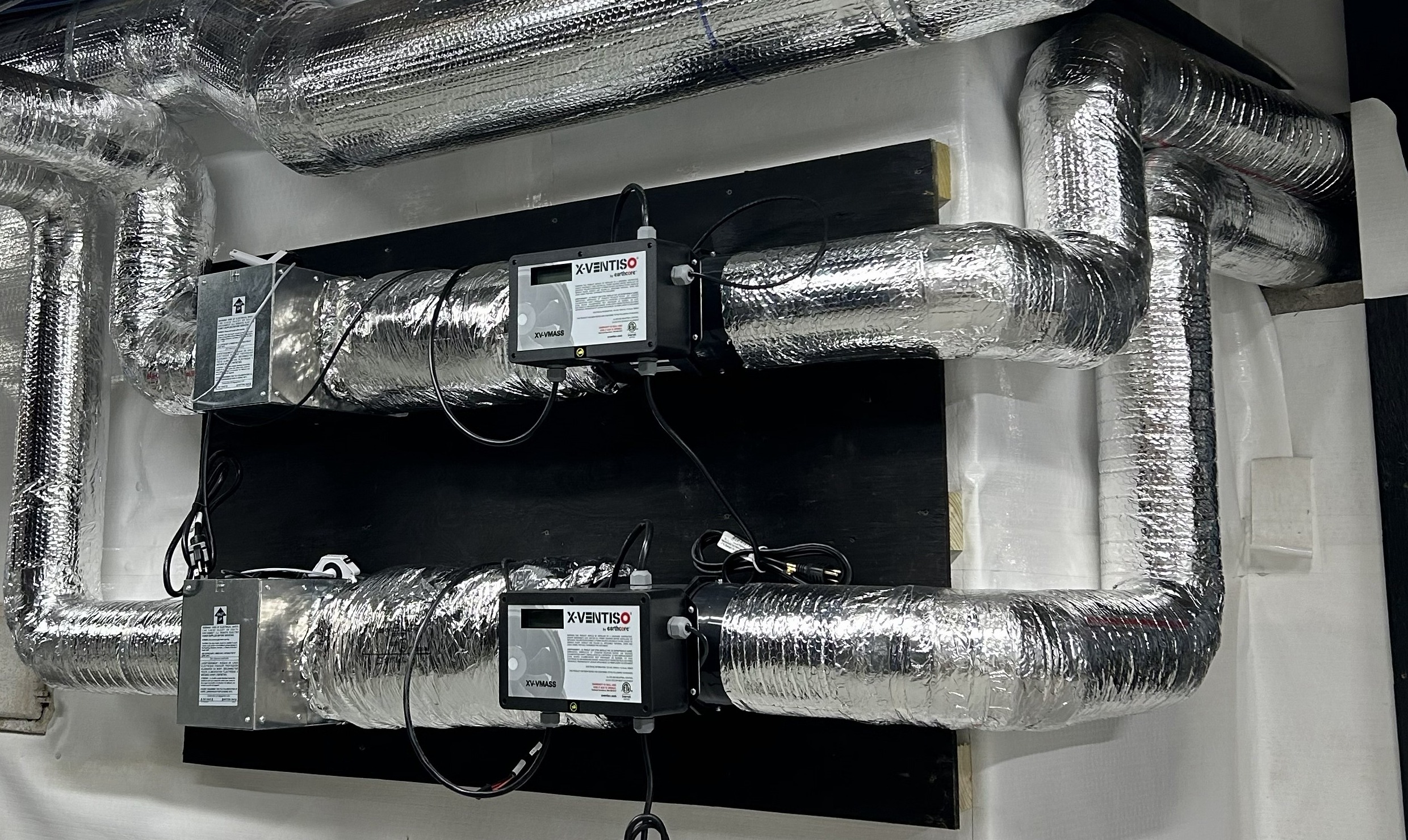
Three kinds of air
Makeup air is the one exhaust forgets.
| Air | Job |
|---|---|
| Ventilation air | Dilutes indoor pollutants for the occupants |
| Makeup air | Replaces what exhaust appliances remove |
| Combustion air | Feeds fuel-burning appliances |
Pair an ERV or HRV for ventilation air with VMASS for makeup air. They do different jobs.
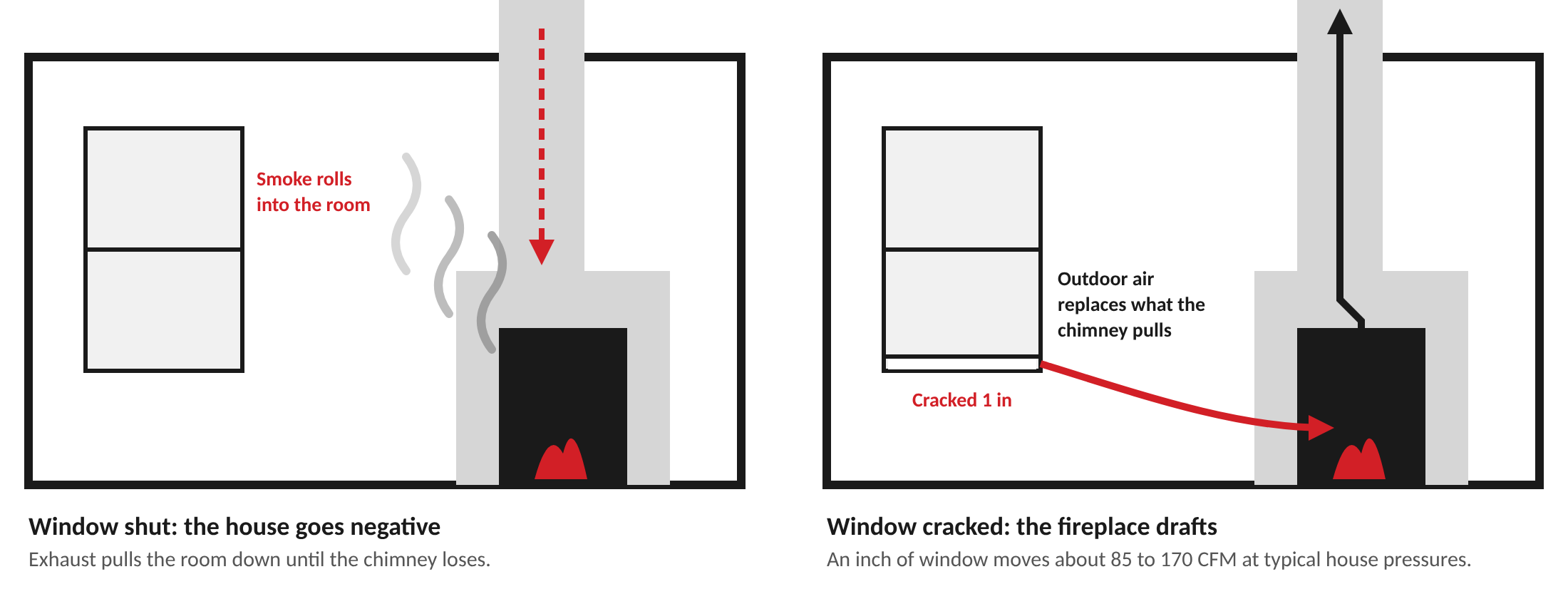
The cracked window
Everyone has seen makeup air work.
Crack a window an inch and a smoky, backdrafting fireplace starts drafting, a trick installers have used for decades.
That inch of window moves far less air than most people expect, because the house already supplies most of the air through its own envelope, and makeup air only has to close the gap.
| Opening | At −5 Pa | At −10 Pa | At −20 Pa |
|---|---|---|---|
| 36" window cracked 1" (36 sq in) | ~85 CFM | ~120 CFM | ~170 CFM |
| Code-maximum fireplace outside air (55 sq in) | ~130 CFM | ~185 CFM | ~260 CFM |
Calculated for a sharp-edged opening. A real duct and grille moves less.
The code agrees
Code sizes fireplace air in square inches, not hundreds of CFM.
IRC R1006 expects a wood-burning fireplace's outside air supply to deliver all of its combustion air through an opening of 6 to 55 square inches, and at the −7 Pa limit for wood-burning appliances, 55 square inches moves only about 150 CFM.
The same section waives the outside air supply when the room is mechanically ventilated and controlled so the indoor pressure is neutral or positive, which means the code measures the result in pressure.
So why size makeup air to the fireplace's full exhaust?
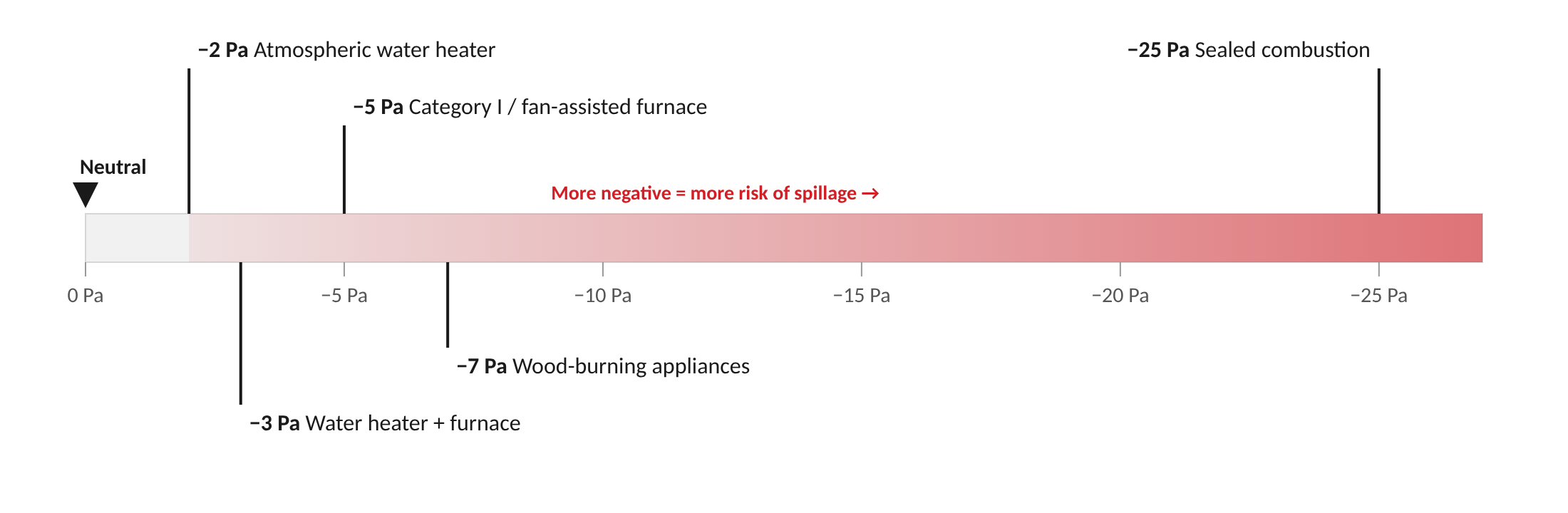
Safety is in Pascals
Every combustion safety limit is set in Pascals.
Combustion safety testing never asks how many CFM a house supplies, only how negative the room gets, with a limit for each kind of appliance.
If safety is judged in Pascals, makeup air should be designed in Pascals too.
| Appliance in the space | Maximum depressurization |
|---|---|
| Atmospheric water heater | −2 Pa |
| Atmospheric water heater and furnace | −3 Pa |
| Category I or fan-assisted furnace | −5 Pa |
| Wood-burning appliances | −7 Pa |
| Sealed combustion, forced draft | −25 Pa |
DOE Standard Work Specifications, combustion appliance zone depressurization limits.
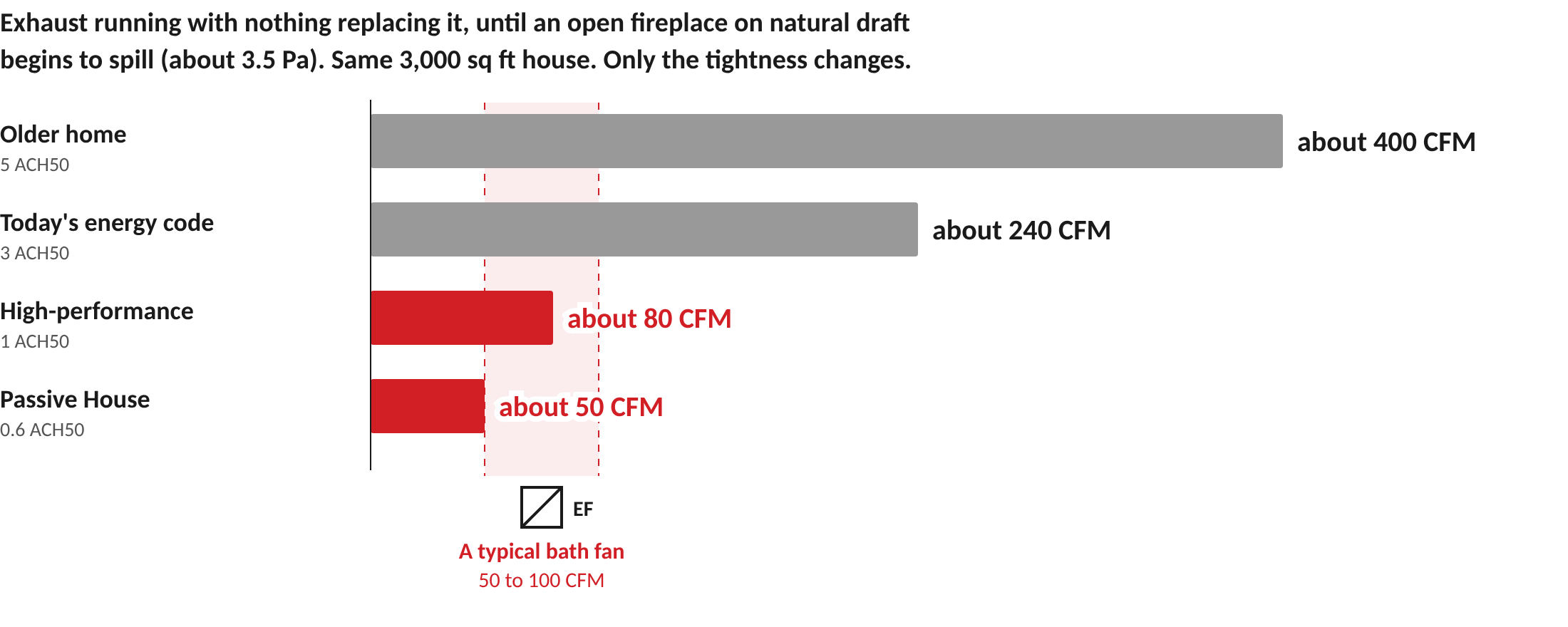
Same CFM, different pressure
The building decides what a CFM is worth.
How much pressure a CFM imbalance creates depends on how tight the building is, so the same 100 CFM that barely registers in an older house can push a Passive House past the spill point of an open fireplace.
Matching CFM in to CFM out ignores the building, while designing to pressure includes it.
| Example house | 100 CFM short | 400 CFM short |
|---|---|---|
| Older home, 5 ACH50 | 0.4 Pa | 3.5 Pa |
| Today's energy code, 3 ACH50 | 0.9 Pa | 7.7 Pa |
| High-performance, 1 ACH50 | 4.9 Pa | 42 Pa |
| Passive House, 0.6 ACH50 | 11 Pa | 92 Pa |
Calculated for a 3,000 sq ft house with 9 ft ceilings, envelope flow exponent 0.65. ACH50: blower-door air changes per hour at 50 Pa. Red: past the 3 to 4 Pa where an open fireplace on natural draft can begin to spill.
How much exhaust does it take to spill a fireplace?
Fire vs opening
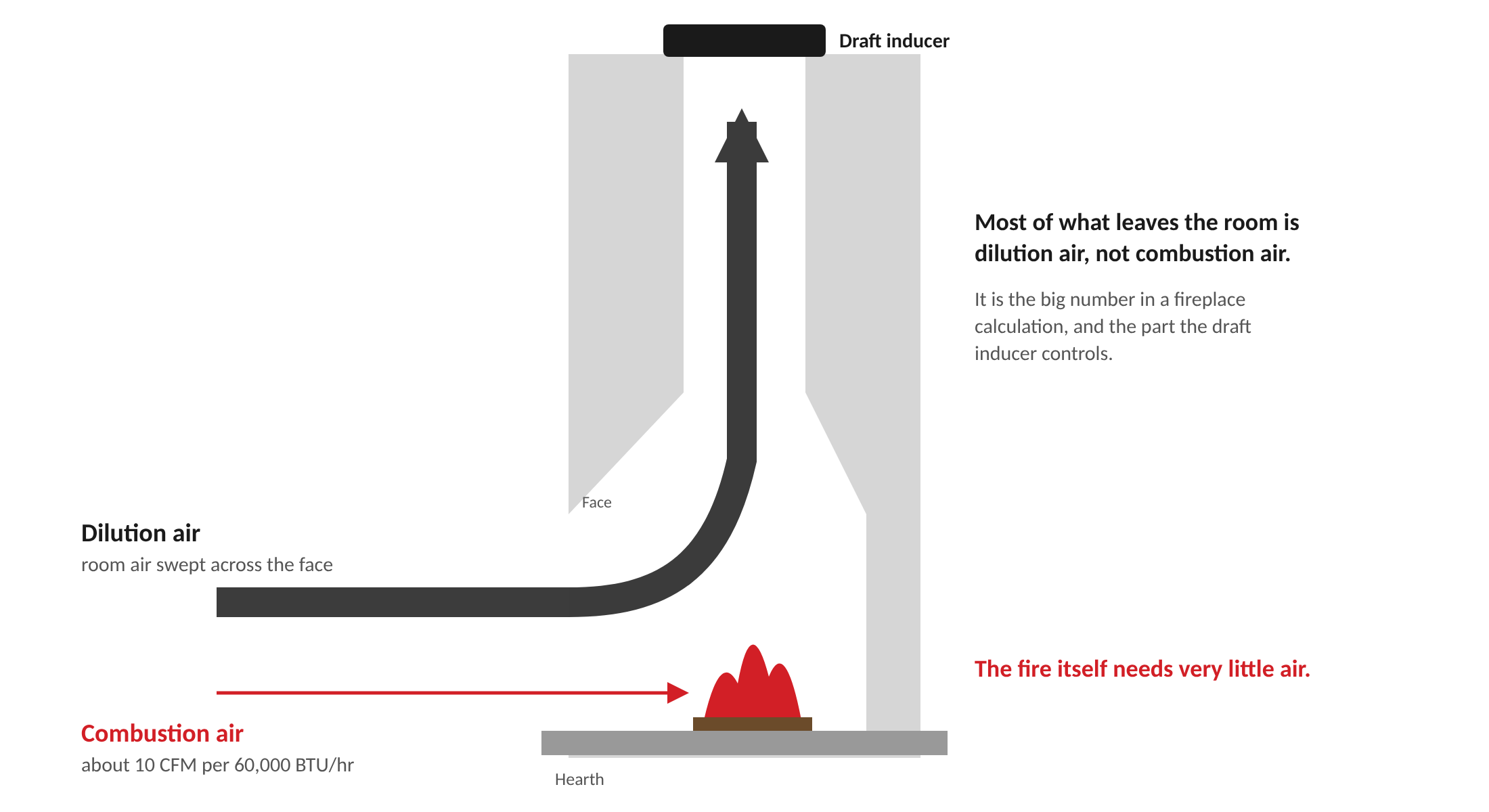
The fire needs very little air. It's the opening that pulls on the envelope.
It takes about 10 cubic feet of air to burn 1,000 BTU of any fuel, so a 60,000 BTU/hr open gas fire needs about 10 CFM to burn, and a vigorous wood fire only slightly more.
Most of what leaves through an open fireplace is dilution air: room air swept up the chimney to keep smoke and fumes in the firebox. It drives the large number in any fireplace calculation, and it is the part a draft inducer controls.
The gas code sizes combustion air the same way, with NFPA 54 calling for one square inch of opening to outdoors per 3,000 BTU/hr, or about 33 square inches for a 100,000 BTU/hr appliance.
| Fireplace | What the fire needs | What leaves the room |
|---|---|---|
| Open gas, with draft inducer | About 10 CFM per 60,000 BTU/hr | Mostly dilution air through the face, controlled by the draft inducer |
| Open wood, with draft inducer | Small, similar to gas | The most dilution air, highest at a cold start |
| Sealed glass-front gas, for comparison | Drawn from outdoors | No room air |
Two numbers, two jobs
Size the fan for the cold start. Size makeup air for the house.
A fireplace calculation sizes the draft inducer with the ASHRAE face velocity method: enough pull across the opening to keep smoke in at a cold start, the worst moment. That number is for sizing a fan, not for sizing makeup air.
Makeup air answers a different question: once the fire is established, how much of the air leaving the room does the building not already supply?
Makeup air needed = operating exhaust − what the envelope supplies at the pressure you allow
| Fireplace drawing 570 CFM of room air | Allow −2 Pa | Allow −5 Pa | Allow −7 Pa |
|---|---|---|---|
| 3,000 sq ft, 3 ACH50 | ~400 CFM | ~270 CFM | ~190 CFM |
| 6,000 sq ft, 3 ACH50 | ~240 CFM | 0 | 0 |
| 3,000 sq ft, 1 ACH50 | ~510 CFM | ~470 CFM | ~450 CFM |
Calculated with the same envelope assumptions as above. Tight houses with large fireplaces can need two VMASS units; most need less makeup air than the fireplace calculation suggests. With a draft inducer on the fireplace, the allowable pressure is set by the other appliances in the house, not the fireplace.
Dial the fan down
Turn the fan down. The makeup air problem shrinks.
The draft inducer decides how much room air leaves through the fireplace, and when it is sized for a cold start, it can pull far more than the fire needs once the flue is warm.
Every CFM the draft inducer doesn't pull is a CFM the house doesn't have to replace. X-VENTISO controllers are commissioned at the lowest speed that holds the draft, and Meridian goes further, modulating continuously to only what the moment needs.
The same turn of the dial also makes the system quieter and sends less heated room air up the chimney.
| Fireplace exhaust | Makeup air needed | VMASS units |
|---|---|---|
| 850 CFM (full speed, cold start) | ~550 CFM | 2 |
| 570 CFM | ~270 CFM | 1 |
| 450 CFM | ~150 CFM | 1 |
| 300 CFM | 0 | Not needed for the fireplace |
Example: 3,000 sq ft house, 3 ACH50, room allowed to reach −5 Pa, where the envelope supplies about 300 CFM. Calculated with the envelope assumptions above.
The cost of too much
Dumping in air has a price.
Moisture
Pushes air into the walls
Supply 600 CFM when exhaust is pulling less, and a code-tight house goes about 14 Pa positive, driving warm, moist indoor air into the building envelope.
Energy
Heats air nobody needed
Warming 570 CFM of 20°F outdoor air to room temperature takes about 9 kW.
Comfort
Drafts and doors
Over-supply shows up as whistling doors, drafts, and rooms that never feel settled.
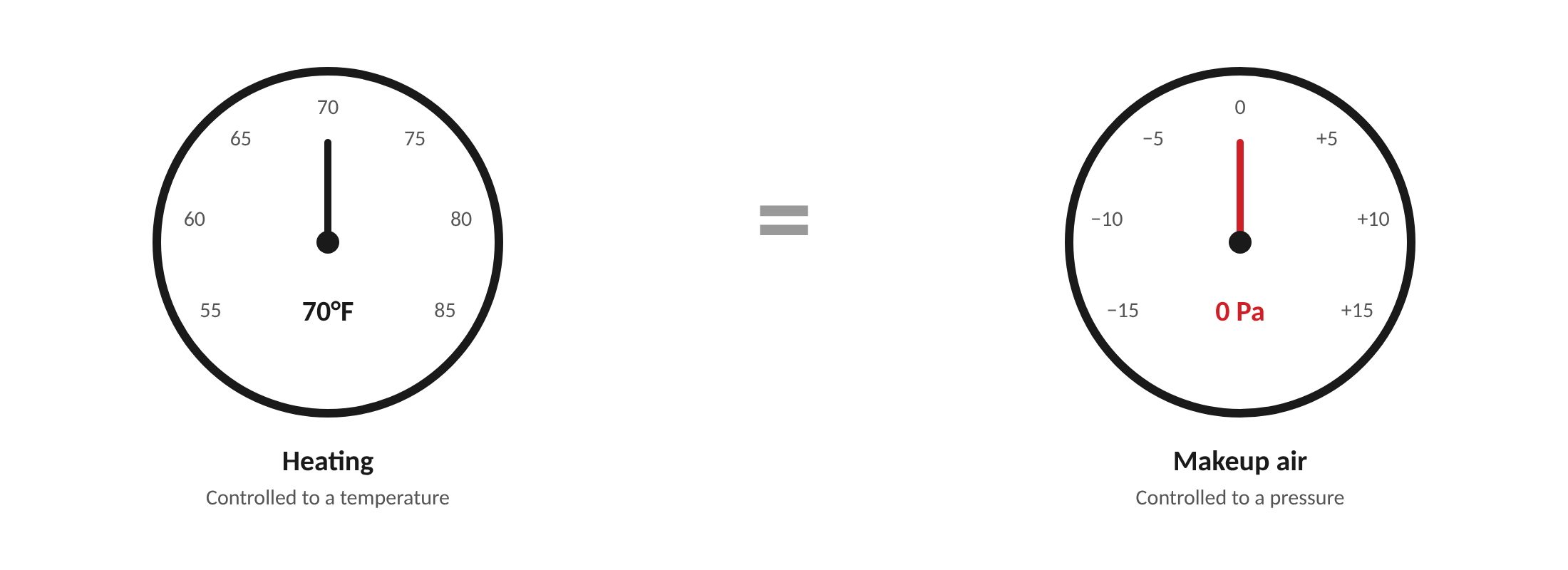
Control it like temperature
Nobody runs a furnace flat out and hopes.
If heating is controlled to a temperature, then makeup air needs to be controlled to a pressure.
A passive opening only lets air in once the room is already negative, because the pressure difference is what pulls the air through, while a fan that senses the room delivers air before the chimney loses.
VMASS controls the zone to neutral against outdoor pressure, within 0.02 in. w.c., and supplies only the air the zone needs.
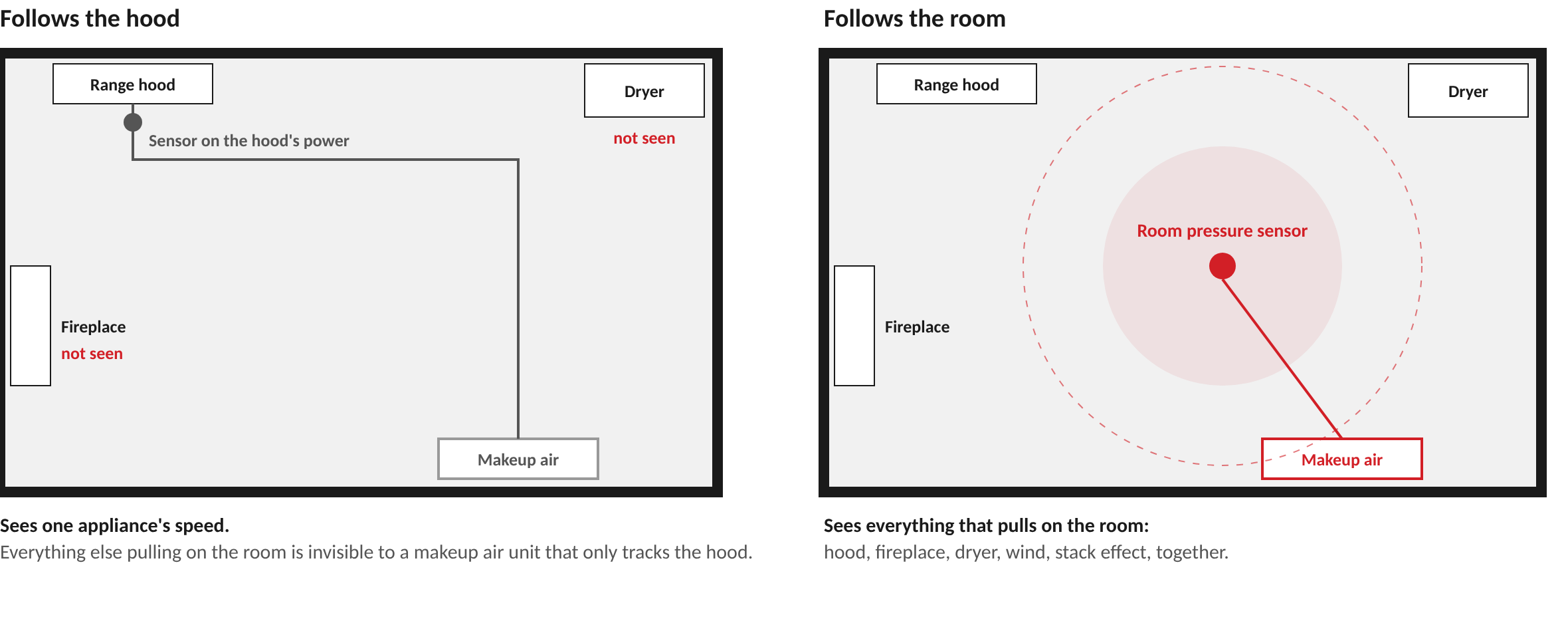
Follow the room, not the hood
Matching the hood's speed is still matching CFM.
Most powered makeup air on the market answers the exhaust fan, not the room. A sensor on the hood's power reads whether it is running high, medium, or low, and the makeup air fan steps to a matching speed set on commissioning day.
It is CFM matching, automated. The house gets balanced to pressure once, at startup, and never checked again. After that the system knows the hood's speed and nothing else.
It cannot see a fireplace or a dryer, because they are not on the hood's circuit. It cannot see how tight the house is, a second exhaust running at the same time, wind, or the stack effect on a January night. It cannot tell whether the room is negative at all.
Where code asks for makeup air matched to a kitchen hood, VMASS is interlocked with the hood and sized to its rating. But a hood is rarely the only thing pulling on the house, and VMASS answers all of it.
A hood-tracking system knows what the hood is doing. VMASS knows what the room is doing.
| Question | Damper that opens with the hood | Fan that tracks the hood's speed | VMASS |
|---|---|---|---|
| Answers to | Hood on or off | Hood speed: high, medium, low | The room |
| Measures | Nothing | The hood's power draw | Zone pressure against outdoors, continuously |
| Supplies | Whatever the negative room pulls in | A preset share of the hood's CFM | Only what holds the zone neutral, 25 to 400 CFM |
| Sees a fireplace, dryer, or second exhaust | No | No | Yes, anything that pulls the zone |
| Knows how tight the house is | No | Once, at commissioning | Every second |
| Tempers the air | No | Heats the full matched airflow | Heats only the air the zone needs |
Five questions
Five questions to ask about any makeup air system.
A lower box price is easy to see. These are the costs that show up after it.
01
What does it measure?
The hood's speed, or the pressure in the room? Only one of them is what the chimney feels.
02
What circuit does the heater need?
Heating 570 CFM of 20°F air to room temperature takes about 9 kW: a 240 V circuit of about 50 A. VMASS plugs into 120 V outlets.
03
What size duct?
Moving hood-matched airflow quietly takes 10 to 12 inch duct through the framing. VMASS runs on 6 inch.
04
Who commissions it?
Calibrating to the hood's speeds and balancing the house takes a technician and a gauge. VMASS is factory-sealed, with nothing to calibrate.
05
What does it cost to run?
Every time the hood goes to high, a hood-matched system heats air the house may never have needed.
Price the whole install, not the box.
Send us the plans and we will size VMASS for the house, with the circuit, duct, and heat it actually needs.
Submit plansThe math
The math behind every number on this page.
Every figure above comes from a handful of standard relationships. Here they are, with the example worked through, so you can run them for your own project.
| Step | Relationship | Worked example |
|---|---|---|
| Building leakage coefficient | C = CFM50 ÷ 50n, where CFM50 = ACH50 × volume ÷ 60 | 3,000 sq ft × 9 ft = 27,000 ft³ at 3 ACH50: CFM50 = 1,350, C ≈ 106 |
| Air the envelope supplies | Q = C × ΔPn, with n ≈ 0.65 and ΔP in Pa | At −5 Pa: 106 × 50.65 ≈ 300 CFM |
| Pressure from an imbalance | ΔP = (Q ÷ C)1/n | 400 CFM short: (400 ÷ 106)1.54 ≈ 7.7 Pa |
| Makeup air needed | Qmakeup = Qexhaust − C × ΔPallowedn | 570 CFM exhaust at −5 Pa: 570 − 300 ≈ 270 CFM |
| Flow through an opening | Q = Cd × A × 4,005 × √ΔP, with A in ft², ΔP in in. w.c., Cd ≈ 0.6 | 36 sq in (0.25 ft²) at −5 Pa (0.020 in. w.c.): ≈ 85 CFM |
| Fireplace exhaust (fan sizing) | Q = face area × face velocity (ASHRAE ≈ 0.8 ft/s) | 45 × 54 in face (16.9 sq ft): ≈ 810 CFM |
| Air the fire burns | About 10 ft³ of air per 1,000 BTU | 60,000 BTU/hr: ≈ 10 CFM |
| Heat to temper outdoor air | kW = 1.08 × CFM × ΔT ÷ 3,412 | 570 CFM from 20°F to 70°F: ≈ 9 kW |
Envelope relationship per the ASHRAE Handbook of Fundamentals, infiltration chapter, with a typical flow exponent of 0.65. 1 in. w.c. = 249 Pa. Results are estimates for comparison; we size each project from its own plans.
Common questions
What engineers ask us.
- Does the house's own leakage really count?
- Yes. Every house leaks, and that leakage supplies part of what exhaust pulls out. The tighter the house, the less it supplies, which is why a high-performance home can reach the spill point with a bath fan running while an older home barely notices 400 CFM. Makeup air closes the gap the envelope leaves.
- What exhaust number should we design to?
- A fireplace calculation sizes the draft inducer for a cold start, the hardest few minutes of the fire. Once the flue is warm, the draft inducer runs at its commissioned speed, and Meridian modulates lower still. The draft inducer you select, and the speed it is set to, decide what the house actually has to replace.
- With a draft inducer on the fireplace, what sets the safe pressure?
- The other combustion appliances in the house. An open fireplace on natural draft can begin to spill at 3 to 4 Pa. A draft inducer sized for the fireplace keeps the chimney in draft well past that, and Meridian pulls harder as the room goes negative. How far depends on the opening, the flue, and the speed, which is what we size for. The limit that matters becomes the next most sensitive appliance in the zone: a water heater, a furnace, or nothing at all in an all-electric or sealed-combustion home.
- Why not a passive opening?
- A passive opening only lets air in once the room is already negative, because the pressure difference is what pulls air through it. It brings in outdoor air at outdoor temperature, and it cannot tell a calm night from a windy one. A powered unit that senses the room supplies air before the room drops.
- What about kitchen hoods?
- For hoods over 400 CFM, code asks for makeup air approximately equal to the exhaust rate, starting automatically with the hood. VMASS is interlocked with the hood and sized one unit per 400 CFM of hood rating. Because it controls to pressure, it also answers the fireplace, the dryer, and everything else pulling on the same zone.
- When does a project need two units?
- When the combined demand in a zone is more than one unit supplies: typically a large open fireplace in a very tight house, or a large hood where code asks for makeup air matched to its rating. Most fireplace zones need one. Send us the plans and we will tell you which yours is.
Q.01
Q.02
Q.03
Q.04
Q.05
Q.06
Local amendments vary. Confirm requirements with the authority having jurisdiction.
We size it
Send us the plans.
Design the zone, not the appliances. We size the draft inducer and the makeup air for the zone together, from your plans, for the house and the climate. One design, one call.